Online Research at the Corvallis-Benton County Public Library
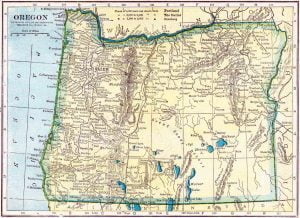
1910 Oregon Census Map

The Corvallis-Benton County Public Library has digitized a wealth of genealogical resources for local history enthusiasts. Key offerings include “Corvallis Chronicles,” detailing the area’s history from 1870 to 1920, and various scanned telephone directories from the 1930s to 1950s. Additionally, the library provides an extensive index of articles on historic buildings and events, as well as a comprehensive account of Benton County’s history. These resources are invaluable for those exploring their genealogical roots in Corvallis and surrounding areas.
Online Research at the Rogue Valley Genealogy Society

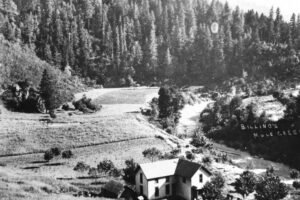
Undated view of the Rogue River Ranch

The Rogue Valley Genealogical Society (RVGS) is located in Medford, Oregon in the Rogue River Valley of Southern Oregon. This page contains a list of the genealogical indexes available on the society website, providing an easy and quick reference for the type and range of records available.

Online Research at Genealogical Forum of Oregon

Main Street looking north Baker City Oregon

The GFO Research Library has more than 60,000 holdings for all of the United States and many locations around the world, with particular strengths in the Pacific Northwest, Virginia, and French Canada. They have also placed online a variety of different indexes which users can search. While largely focused on Oregon and the communities within the state, it does have some non-Oregon based genealogy information online.

Pioneer Days in Malheur County

Exterior Court of Old Fort Hall

“Pioneer Days in Malheur County” by Jacob Ray Gregg is a comprehensive historical account that seeks to perpetuate the memory of prominent pioneers and preserve an authentic history of Malheur County, Oregon. This privately printed volume, published in 1950 by L. L. Morrison in Los Angeles, spans 442 pages and provides a broad narrative of the region’s history, covering significant events and developments from the mid-19th century onwards. Key locations discussed include Ontario, Vale, Nyssa, Westfall, Harper, Juntura, Ironside, Brogan, and Jamieson. The work also delves into critical historical topics such as the Bannock War and the Overland Trail, alongside accounts of early pioneer life.

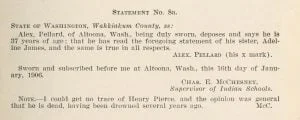
Statement No. 8a – Alexander Pellard, Jr. of Altoona

Statement No 8a

This document, communicated by the acting commissioner of Indian Affairs, addresses the rolls of specific Indian Tribes in Oregon and Washington, particularly in relation to an 1851 agreement. Statement No. 8a features Alexander Pellard, Jr., a member of the Lower Chinook Indians, affirming the accuracy of his sister Adeline’s statement in 1906. His sworn testimony, part of the McChesney Rolls, highlights the identification of enrolled Chinook individuals distinct from reservations and includes details about Pellard’s age.

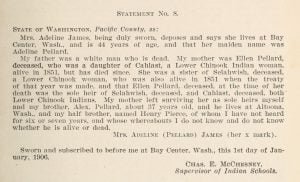
Statement No. 8 – Adeline (Pellard) James, of Bay Center

Statement No 8, McChesney Roll

Statement No. 8 is a sworn testimony by Adeline (Pellard) James, a member of the Lower Chinook tribe, recorded in 1906. In her account, she details her lineage back to her mother, Ellen Pellard, and her Lower Chinook ancestry, linking her family to the 1851 treaty with the United States, which was never ratified. Adeline discusses her deceased relatives who were alive during the treaty, their fates, and her remaining family members. This document serves as a historical reference for the Lower Chinook community.

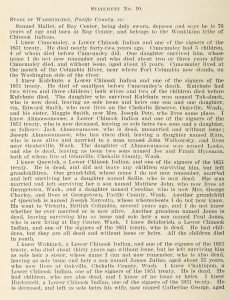
Statement No. 10 – Samuel Mallet of Bay Center

Statement No 10, part 1

In Statement No. 10, Samuel Mallet, a 76-year-old member of the Waukikum tribe, recounts the fates of various Lower Chinook Indians who signed an unratified treaty with the U.S. in 1851. Mallet details the lives and descendants of these individuals, many of whom have died without heirs, while others left surviving relatives located in Washington. His testimony offers a glimpse into the lineage and historical context of the Lower Chinook tribe’s connection to the treaty and their subsequent circumstances.

Lower Chinook, Kathlamet, Tillamook, and Clatsop Indians, Alive in 1906

In 1906, Charles E. McChesney compiled a list of the Lower Chinook, Kathlamet, Tillamook, and Clatsop Indians, along with their heirs, who had treaty agreements with the U.S. government since 1851. The document includes numerous names and corresponding addresses across various locations, such as Oregon, Washington, and California. This registration underscores the ongoing recognition of these tribes and serves as an important historical record of their existence and relocations during that period.

Treaty of August 9, 1851 – Lower Chinook

The Treaty of August 9, 1851, otherwise known as the Tansey Point Treaties of 1851, details an agreement between the United States government and the Lower Band of Chinook Indians. In the treaty, the Chinook cede a significant portion of their land to the United States, with boundaries meticulously defined based on geographical features and previous agreements. However, the Chinook retain certain rights to the land, including occupancy, fishing, grazing, and cranberry harvesting. In exchange for this cession, the United States agrees to provide the Chinook with annual payments of goods and money for a decade. The treaty emphasizes a desire for peace between the parties and includes stipulations for its ratification and implementation.

1910 Modoc Census

1910 Modoc Census - Page 1

Pages of the 1910 Modoc Census. Contains table showing the previous roll number, current roll number, Indian name if given, English name if given, Relationship, Age, and Sex. Also contains the original images of the census.

Revolutionary War Pension and Bounty Land Warrants

Civil War Cannon

This article helps you access the Revolutionary War Pension and Bounty Land Warrants for free. Following two simple steps, one to search, and the other to browse the actual microfilms, you can quickly find your ancestors Revolutionary War pension record, or Bounty-Land record and download the images. During 1800-1900 the United States issued more than 80,000 pensions and bounty-land-warrants to soldiers of the Revolutionary War, their spouse, or their children. Was your ancestor one of them?

ORGenWeb – Oregon Genweb

1910 Oregon Census Map

ORGenWeb was created by a group of volunteers as part of the USGenWeb Project working together to provide free genealogy websites for genealogical research in every county in Oregon. This Project is non-commercial and fully committed to free genealogy access for everyone.

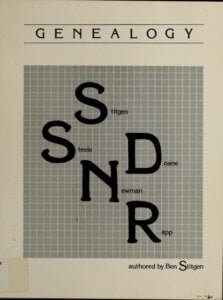
Genealogy: Stitgen, Steele, Doane, Newman, Rapp

Genealogy: Stitgen, Steele, Doane, Newman, Rapp

The Stitgen family comprises most of the book, and starts with Theodor and Barbare (Wollgrafs) Stutgen (the family would variously spell their name as Stutgen, Stuttgen, Stuettgen, and Stitgen.) Theodore Stitgen, grandson of Theodor Stutgen would immigrate to Richfield, Wisconsin about 1850 and eventually settled in Hillsboro, Oregon.

The Doane family starts with Christina Barnet from Annandale Scotland, who’s husband _____ Doane, died while in Scotland. She settled in Waunakee Wisconsin in 1853, with her twin sons, Andrew and Peter. The progenitor of the Rapp family, Peter and Susan (Marsh) Rapp, started in Pennsylvania and moved their family to Dane Township, Wisconsin in 1848. The Steele family starts with Robert and Nancy (Dunshee) Steele of Armagh County, Northern Ireland, who met on the voyage to America in 1801. They settled near Bovina, Delaware County, New York. The Newman family starts with John and Mary Newman of Polajewo Poland. They immigrated to America together in 1853 and settled in Madison, Wisconsin.

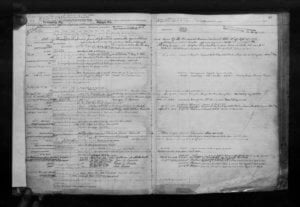
United States Bureau of Land Management Tract Books, 1800-c. 1955

record-image_3QS7-89W3-39QL-W

3,907 land management tract books containing official records of the land status and transactions involving surveyed public lands arranged by state and then by township and range. These books indicate who obtained the land, and include a physical description of the tract and where the land is located. The type of transaction is also recorded such as cash entry, credit entry, homesteads, patents (deeds) granted by the Federal Government, and other conveyances of title such as Indian allotments, internal improvement grants (to states), military bounty land warrants, private land claims, railroad grants, school grants, and swamp grants. Additional items of information included in the tract books are as follows: number of acres, date of sale, purchase price, land office, entry number, final Certificate of Purchase number, and notes on relinquishments and conversions.

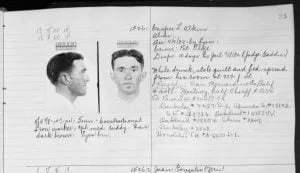
Sacramento California Police Mug Books 1864-1949

Mug Book cropped

Mug Books of the past have been replaced by computer databases now, but back before the days of computers and databases, they served as an effective method for Police Departments to keep track of past criminals and wanted people. The Sacramento Police Department has generously provided these scanned images to archive.org for free access to everyone. If you are not aware if one of your ancestors may have been arrested for a crime, then I suggest you first search the newspaper records available online for free of Sacramento California, so that you have a year span to choose from. Unless you’re like me and just like perusing the old mug shots…

Chronicling America Historical Newspapers

Winchester Star

Chronicling America is a Website providing access to information about historic newspapers and select digitized newspaper pages, and is produced by the National Digital Newspaper Program (NDNP). NDNP, a partnership between the National Endowment for the Humanities (NEH) and the Library of Congress (LC), is a long-term effort to develop an Internet-based, searchable database of U.S. newspapers with descriptive information and select digitization of historic pages. Supported by NEH, this rich digital resource will be developed and permanently maintained at the Library of Congress. An NEH award program will fund the contribution of content from, eventually, all U.S. states and territories.

Oregon World War 2 Casualties – Army, Air Force

World War 2 Casualties - Army, Airforce

This database contains War Department casualties (Army and Army Air Force personnel) from World War II for Oregon. Information provided includes serial number, rank and type of casualty. The birthplace or residence of the deceased is not indicated. An introduction explaining how the list was compiled, a statistical tabulation, and the descriptions of the types of casualties incurred are also included.